What happened
Google DeepMind published WeatherNext Cyclones in Nature on August 6 and released the forecasting code and pretrained weights for research use.
The paper's authors include researchers from Google DeepMind and Google Research as well as forecasters and scientists from the US National Hurricane Center, Colorado State University's Cooperative Institute for Research in the Atmosphere, and the UK Met Office. Google says the model was tested on historical tropical cyclones from 2023 and 2024, with annual versions trained only on data available before the evaluation year.
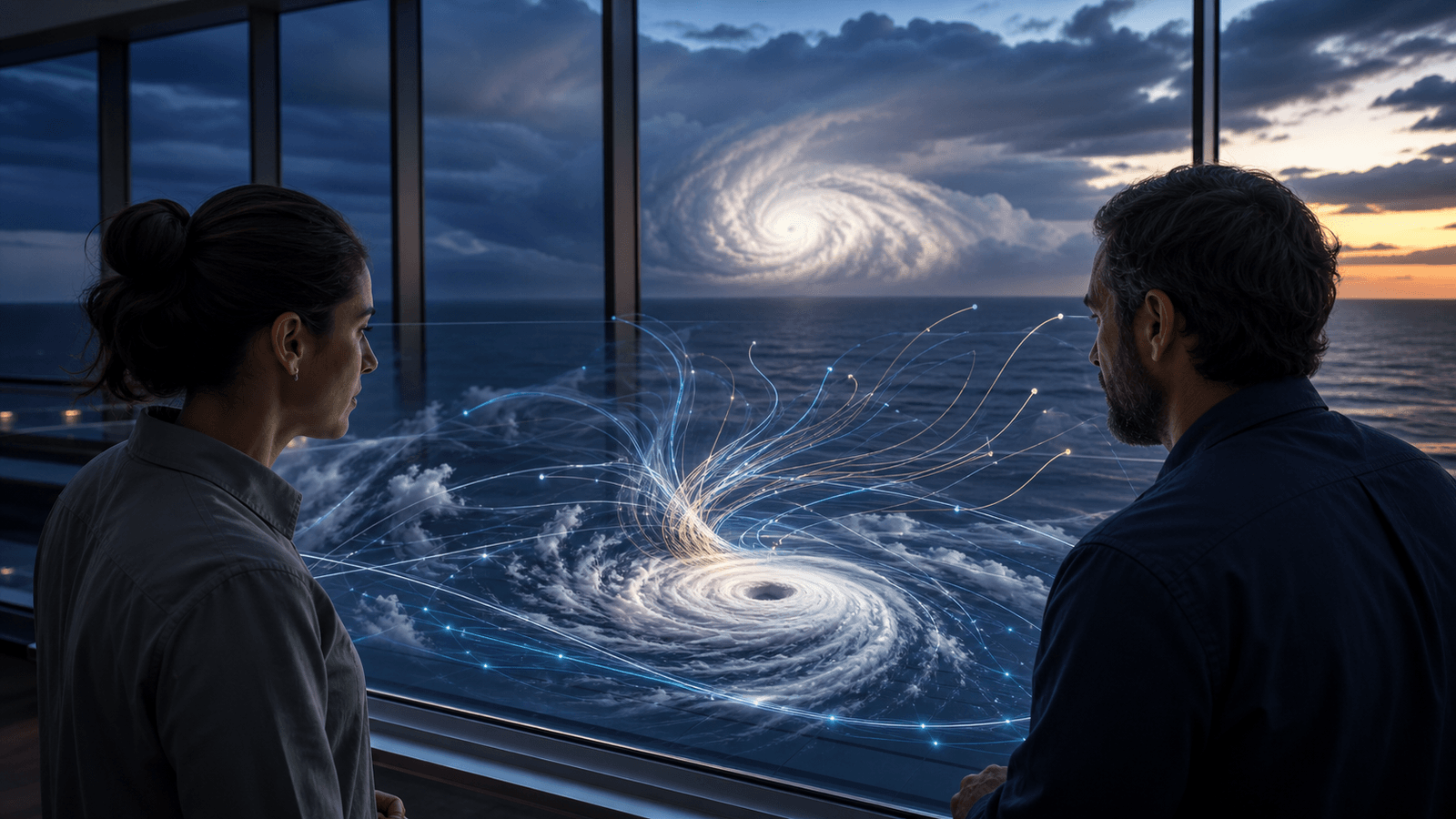
Across track, intensity, and wind-structure measures, Google reports more than 24 hours of average lead-time advantage over leading comparison systems. In plain terms, its three-day predictions reached about the accuracy that earlier systems delivered at two days. The result covers both deterministic forecasts and ensembles, which estimate a range of plausible storm outcomes rather than a single path.
WeatherNext combines global atmospheric data with expert-curated cyclone records. Google says training used nearly 20 terabytes of atmospheric data and almost 5,000 storms from the IBTrACS archive. The system can forecast up to 15 days ahead and generate a 1,000-member ensemble; the company says one forecast takes less than a minute on a TPU.
Read the primary source: Google DeepMind WeatherNext announcement and Nature paper ↗
Why it matters
Cyclone forecasting has long forced a trade-off between modeling the large-scale currents that steer a storm and the fine-scale processes that determine its strength. One model that improves both could give expert forecasters more useful time to assess evacuations, staffing, and emergency supplies.
The release is more than a research announcement. Google has published the WeatherNext code, model weights, documentation, and a compact Mini version under open licenses. That gives universities, weather agencies, and nonprofits a path to reproduce the published system, test it in regional settings, and build specialized tools instead of relying only on a hosted demonstration.
The model has also been exposed to operational practice. A WeatherNext version ran during the 2025 Atlantic hurricane season and was available to National Hurricane Center forecasters as guidance. Google says it anticipated Hurricane Melissa's rapid intensification and Jamaican landfall five days ahead, but the official forecast and public warnings came from the center's human forecasters.
That distinction is essential. Earlier model guidance can improve a decision only when trained forecasters compare it with observations, physical models, and local knowledge. Google and the public repository both state that WeatherNext is experimental research and does not replace alerts from national or local meteorological services.
What to watch next
Watch for independent replication across more ocean basins, rare rapid-intensification events, and complete storm seasons using frozen models and real operational inputs.
The headline lead-time result is an average over historical tests, not a promise that every storm will be predicted a day earlier. Local impacts such as rainfall, flooding, storm surge, and neighborhood-scale wind damage require additional models and observations, and a confident ensemble can still miss an outcome outside the patterns represented in its data.
Access also has practical limits. The repository describes the code as research software with no guarantee of API stability, says the full models require substantial accelerator memory, and notes that the compact Mini model is not expected to match the larger versions. Reproducing a benchmark is different from operating a reliable public-warning service around the clock.
The most valuable follow-up evidence will come from meteorological agencies publishing side-by-side verification, calibration, failure cases, and examples of how the guidance changes human forecasts. Open weights make that scrutiny possible; transparent operational evaluation will show whether the reported gain travels beyond the original collaboration.