What happened
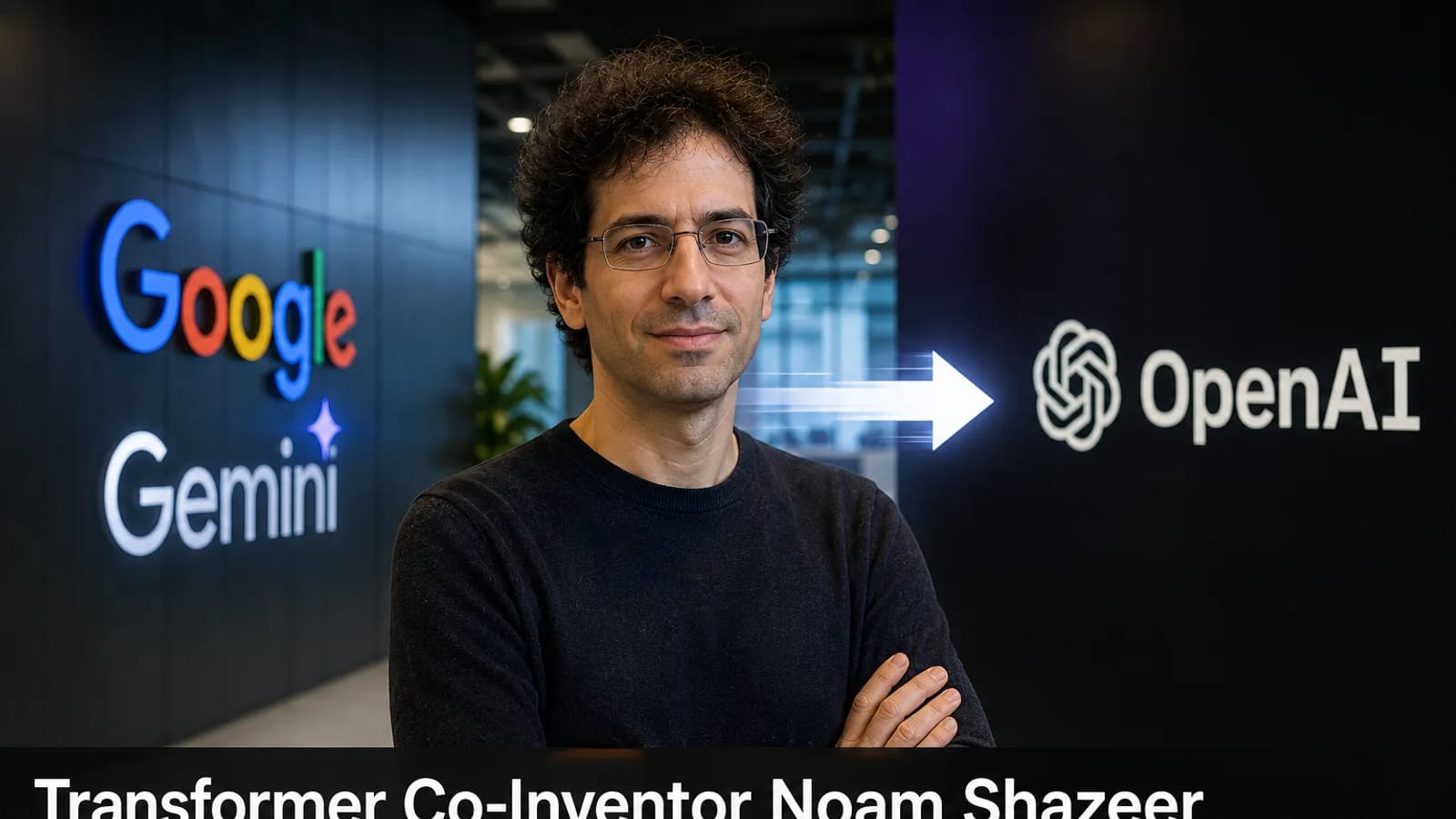
Noam Shazeer, a vice president of engineering at Google and co-lead of its Gemini AI models, announced on June 18 that he is leaving the company to join OpenAI, where he will lead research on AI architecture — the fundamental design of how advanced models are built.
"I'm excited to share that I'll be joining OpenAI and look forward to working with the exceptional team there," Shazeer wrote in his announcement, adding that it was a difficult decision to move on and that he was proud of what the Google team had built.
Why this name matters
Few individual departures in the technology industry carry this much weight. Shazeer is a co-author of the 2017 research paper "Attention Is All You Need," which introduced the Transformer — the architecture that underpins essentially every major AI model in use today, including GPT, Gemini, and Claude. The "T" in ChatGPT stands for Transformer.
His career has also traced the industry's strangest economics. Shazeer left Google in 2021 to co-found the chatbot startup Character.AI. In 2024, Google struck a deal reported at around 2.7 billion dollars — largely, by most accounts, to bring him and his co-founder back. He then became one of the leaders of the Gemini effort, Google's flagship AI program. Less than two years later, he is leaving again, this time for Google's most direct rival.
The talent war intensifies
The move lands in the middle of an already fierce competition for a small pool of senior AI researchers. Over the past two years, the major labs have traded high-profile researchers back and forth, with compensation packages reported in the tens and sometimes hundreds of millions of dollars. Shazeer's switch is among the most significant yet: he was not just a researcher at Google but a co-lead of its most important product line.
For OpenAI, the hire fills a specific need. The company has been public about pursuing new model architectures as the gains from simply scaling up existing designs become harder to win. Bringing in one of the inventors of the current dominant architecture is a direct bet that the next breakthrough will come from rethinking the foundations.
Why it matters
- Ideas travel with people. The biggest advances in AI have repeatedly come from small groups of researchers, and when those researchers move, the center of gravity of the field can move with them.
- A signal about what comes next. Hiring an architecture specialist of this stature suggests OpenAI believes future progress depends on new designs, not just bigger versions of today's models.
- Google's retention challenge. Google originated much of modern AI research, including the Transformer itself, yet it continues to lose the people behind that work to competitors — a long-running pattern that this departure extends.
What to watch next
Research payoffs take time, so the effects of this move will not be visible in the next model release. Watch instead for how Google restructures Gemini leadership, whether other senior researchers follow Shazeer's path in either direction, and — over a longer horizon — whether OpenAI's architecture research produces models that break from the Transformer lineage Shazeer helped create.