What happened
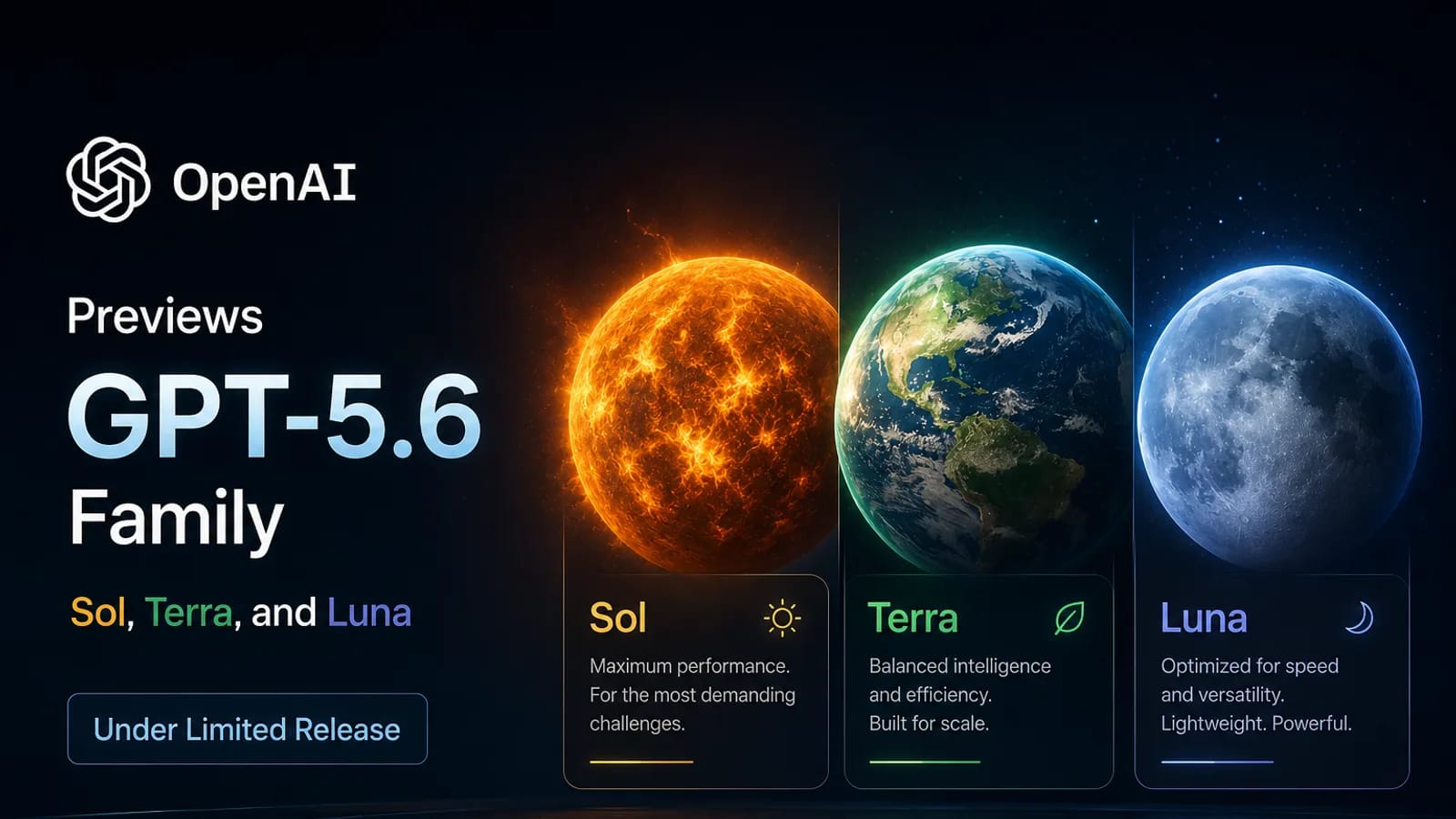
On June 26, OpenAI announced GPT-5.6, a family of three models named Sol, Terra, and Luna. Rather than making them available to everyone at once, the company began with a limited preview for a narrow set of roughly twenty organizations, with general availability promised in the coming weeks.
The three models cover different points on the cost-and-capability spectrum. Sol is the flagship, aimed at the hardest reasoning, coding, and cybersecurity work. Terra is the balanced middle option, which OpenAI says performs competitively with the previous GPT-5.5 while costing half as much. Luna is the fast, low-cost model for high-volume tasks.
Announced API pricing per million tokens is 5 dollars in and 30 dollars out for Sol, 2.50 and 15 for Terra, and 1 and 6 for Luna.
A more cautious rollout
What sets this launch apart is the process around it. OpenAI said it shared the models and its release plans with the U.S. government before the preview began — a step reported by Axios and VentureBeat, and one that follows a June executive order asking developers to voluntarily give the federal government early visibility into significant new models.
The company also described the release as carrying its most robust safety stack to date, particularly on Sol, with strengthened protections around higher-risk activity, sensitive cybersecurity requests, and repeated attempts at misuse. The context is hard to miss: earlier in June, the government forced Anthropic to temporarily shut down its most capable models over security concerns. A staged rollout with government notification looks like an attempt to avoid a similar collision.
What the names signal
The sun-earth-moon naming (Sol, Terra, Luna) maps onto a pattern the whole industry has converged on: one premium model for the hardest problems, one workhorse for everyday tasks, and one inexpensive model for scale. Anthropic, Google, and OpenAI now all ship tiered families rather than single models, and most users will interact with the middle and lower tiers, not the flagship.
Why it matters
- The release playbook is changing. Frontier models are no longer simply launched; they are staged, reviewed, and in some cases shown to the government first. GPT-5.6 may be the template for how major AI releases work from now on.
- Prices keep falling for the same capability. If Terra genuinely matches GPT-5.5 at half the cost, the practical price of high-end AI has dropped again within months — a pattern that has repeated every generation.
- Safety is now a launch feature. OpenAI led its announcement with safeguards rather than benchmark scores. Whether driven by conviction or regulation, that is a meaningful shift in how these systems are presented to the public.
What to watch next
The immediate question is timing: OpenAI says general availability is weeks away, and any slip would suggest the review process is heavier than described. Watch also for independent testing once the models are broadly available — preview-partner impressions tend to be favorable by selection — and for whether the voluntary government-notification step becomes an expectation for every lab, formalized in policy, or quietly abandoned. How Sol's restrictions on cybersecurity requests work in practice will be an early test of whether safety features and usefulness can coexist.